In this guide
- One job title can conceal several separate questions
- The five-field position profile
- What the public definitions establish
- Workload is not a weekly diary
- Worked example: two appealing research-support roles
- Treat organization as a real field
- Benefits need their own evidence conversation
- Recheck the profile at the point of change
- Sources and evidence limits
One job title can conceal several separate questions
An administrative coordinator, research specialist, or technician title gives a useful hint about work. It does not by itself tell a reader how the position is classified, how long it is expected to last, or which benefit rules apply. A productive comparison begins with a position profile. This is a small evidence sheet that records distinct facts without forcing them into one label. It is especially useful when moving between university units, considering a second assignment, or comparing an offer with a job someone already holds.
The five-field position profile
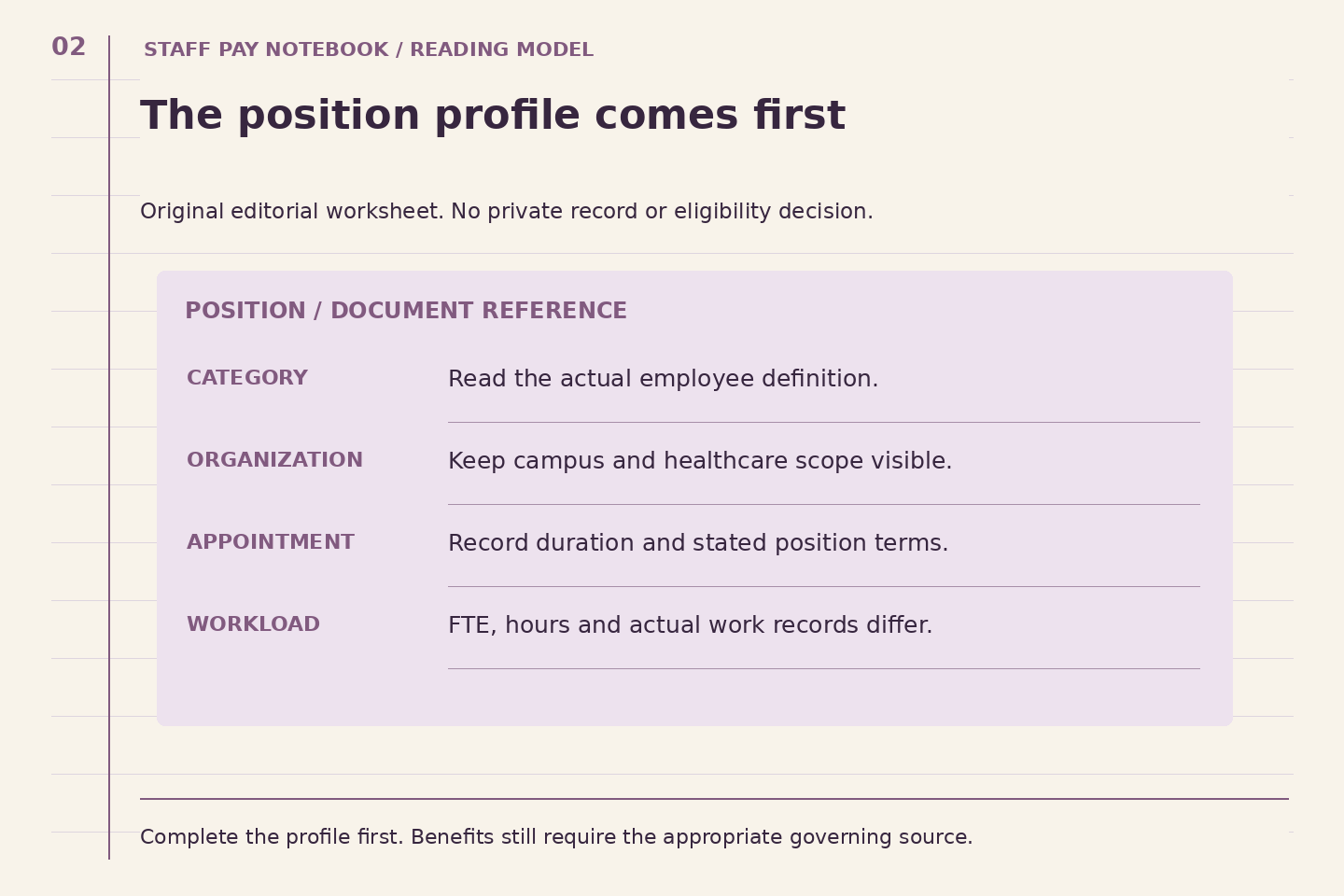
Use five fields: employee category, organizational scope, workload, pay basis, and expected duration. Give each field both a value and its source. "Not stated" is an acceptable value. A posting may answer workload but leave a schedule question unresolved; an offer may describe duration more clearly than a general career page. Keep benefit questions alongside the profile rather than treating benefits as a sixth fact that can be guessed from the others. This structure makes it easier for a recruiter or HR representative to correct one assumption without rewriting the whole comparison.
What the public definitions establish
Policy 5-001 distinguishes staff, faculty, non-faculty academic employees, and administrative officers. It defines FTE in relation to expected workload and, for non-faculty employees, a 40-hour normal full-time week. Its full-time threshold is .75 FTE; part-time is .74 or less. Benefits eligibility is a separate defined concept linked to Policy 5-308. Policy 5-001's current revision is effective January 1, 2026. These published definitions are a vocabulary for questions, not a determination of a reader's appointment or benefit enrollment.
Workload is not a weekly diary
A stated FTE describes a position's workload relationship. A time record describes what happened on particular dates. Keep those concepts apart when investigating a busy week, an absence, or a proposed schedule change. A single week does not necessarily tell you the position's recorded FTE. Conversely, a percentage alone does not explain the actual arrangement of days and hours. Ask about both the appointment field and the working pattern. That distinction helps a candidate discover whether a schedule meets practical needs without turning an informal expectation into an official classification.
Worked example: two appealing research-support roles
Imagine an applicant comparing two hypothetical research-support positions. One posting says .75 FTE and describes ongoing administrative support. Another says 1.0 FTE and identifies a project end date. Neither title resolves all five fields. The applicant records the stated workloads, copies the duration language into a private comparison note, and marks employee category and benefit applicability for confirmation. They do not rank the second position as automatically more secure or the first as automatically ineligible for benefits. Both judgments would skip information that the evidence sheet deliberately leaves open.
The applicant prepares different questions for each role. For the ongoing-support role: what is the expected weekly schedule, and which appointment category will appear in the offer? For the project role: what does the listed end date mean for this position, and what would an extension require? For both: which current benefit materials apply to this appointment? The exercise produces a focused conversation rather than a numerical score built from assumptions. No salary, eligibility outcome, or likelihood of renewal is being inferred in this example.
Treat organization as a real field
The phrase University of Utah Health can appear around several kinds of work. A building address, clinical setting, or broad brand is not enough to settle which employment guidance applies. Ask for the unit and appointment scope in writing when that distinction matters. Then read the scope statement of the relevant policy before studying its detailed provisions. This is a useful general research habit: the most precise rule in the wrong population still gives the wrong answer. An organizational label should help narrow the source, not replace a source check.
Benefits need their own evidence conversation
The official benefits eligibility chart is the next source when a benefit question arises, but a chart still needs the correct position information. List the benefit being discussed instead of asking whether the job "has benefits" as a single yes-or-no question. For example, ask which materials describe health coverage, leave, retirement, or other programs for the proposed appointment. Request clarification of any waiting, enrollment, or effective-date issue from the responsible office. This guide deliberately does not calculate eligibility or recommend an individual benefit election.
Recheck the profile at the point of change
A profile is most useful when it is dated and attached to a particular position or offer. Refresh it after a documented change in workload, duration, category, or organizational assignment. Preserve the earlier version if you need to understand what changed; do not silently overwrite its dates. October 1, 2026 is the source-check date for this article, separate from policy effective dates and the dates of any personal employment action. The outcome is a clearer set of facts and questions, not a substitute for the University's determination.
Try the Five-Clocks Reading Lab to prepare a bounded question.
Continue reading: Read a Pay Statement by Asking What Each Number Represents, Two University Jobs: Keep Time Attached to the Right Assignment, Campus and Healthcare Jobs: Read the Scope Before the Label.