In this guide
One university identity can support different roles
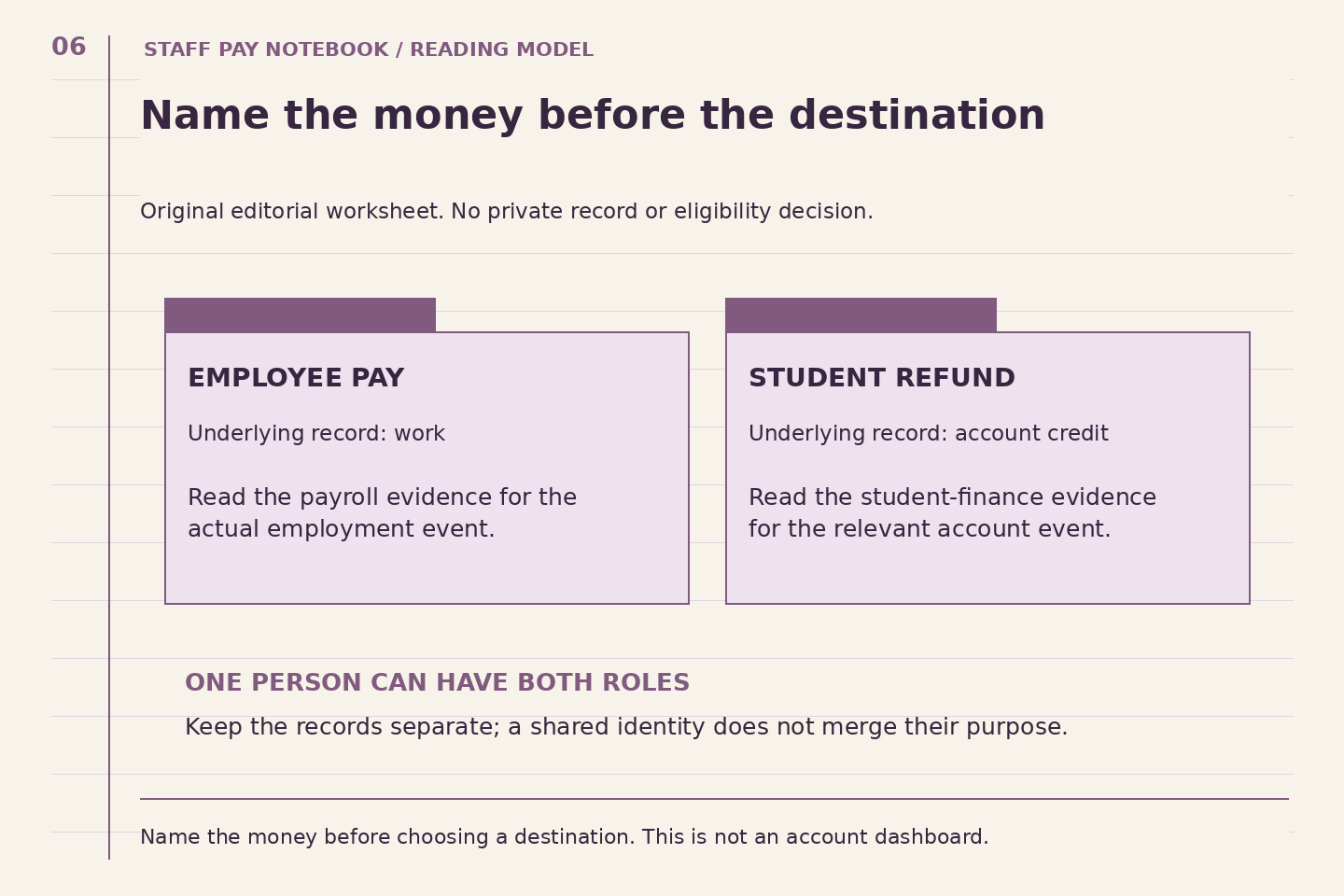
A person can work for the University and also study there. That does not make every payment or balance part of payroll. The first useful question is what the money represents. Is it compensation for work, a tuition-account credit, or another transaction? Answering that question narrows the relevant record and office. A shared sign-in environment or the appearance of direct deposit in two sets of instructions does not establish that the underlying processes, authorizations, or timing are interchangeable.
Create a payment-purpose map
This article's map has three boxes: reason for money, originating record, and responsible office. Begin with the reason in ordinary words. "Hours worked during these dates" points to an employment question. "Credit remaining on a tuition account" points to a student-account question. If the reason is unknown, leave it unknown and ask for clarification before changing anything. Do not categorize a deposit only by its amount, bank description, or proximity to a familiar payday; those clues can be incomplete.
What the official sources distinguish
University HR publishes employee paycheck information and payroll resources. Separately, Financial Aid's Disbursement of Funds page describes aid crediting a student's tuition account and student-account credits being paid through the described refund process. Its page was last updated September 17, 2026 when checked for this guide. These sources establish separate subjects and routes. They do not allow this site to determine whether a particular student is eligible for aid, when a personal refund will arrive, or whether an employee's payment was processed correctly.
Worked example: two expected payments
Imagine a hypothetical student employee who expects wages for campus work and also sees a possible credit on a tuition account. They make two lines in their note. The wage line lists work dates, position, and the relevant payroll question. The tuition line lists the term and the account item that needs explanation. They do not combine the two into an expected bank total. Each line remains open until the appropriate office confirms what it represents and which process applies.
Suppose the wages arrive but the student-account question remains unresolved. The employee closes only the wage line after checking the relevant employment record. They do not treat the missing second amount as a payroll shortage, and they do not assume that a payroll direct-deposit action also completed a student-account authorization. They follow the current official student-account instructions or ask the responsible office. This is a fictional organizational example, not a prediction about payment timing or a recommendation about managing personal funds.
Ask a question that names the underlying record
A concise inquiry might ask which tuition-account item explains a credit, or which pay statement includes specified work. That is more useful than asking why money from the University is missing. Keep the two records separate when gathering evidence, and avoid sharing a full academic or employment history when only one item is relevant. If the office redirects the question, note the verified destination and retain the original purpose so the inquiry does not gradually lose its context.
Keep the map as a reference, not an account dashboard
This independent site does not display balances, connect to CIS, accept bank details, or provide personal aid and tax advice. The map is simply a way to label a question accurately before using official resources. Source checking occurred October 1, 2026; that date is not a promised disbursement date. When the nature of a payment remains unclear, preserve the uncertainty and ask rather than constructing a connection from two processes that happen to share a university name.
Continue reading: Build a Job-Posting Evidence Sheet Before You Apply, Compare Posted Pay Ranges Without Inventing a Salary, A First-30-Days Routine for Learning the Work and Keeping Useful Records.