In this guide
- A useful packet answers a narrow question
- Keep events and evidence in separate columns
- Understand the boundary of a personnel file
- Worked example: a transfer date is inconsistent
- Separate a request from a completed transaction
- Minimize the information that travels
- Define what a satisfactory answer would establish
- Keep follow-up factual and proportionate
- Close the ledger without erasing its history
- Sources and evidence limits
A useful packet answers a narrow question
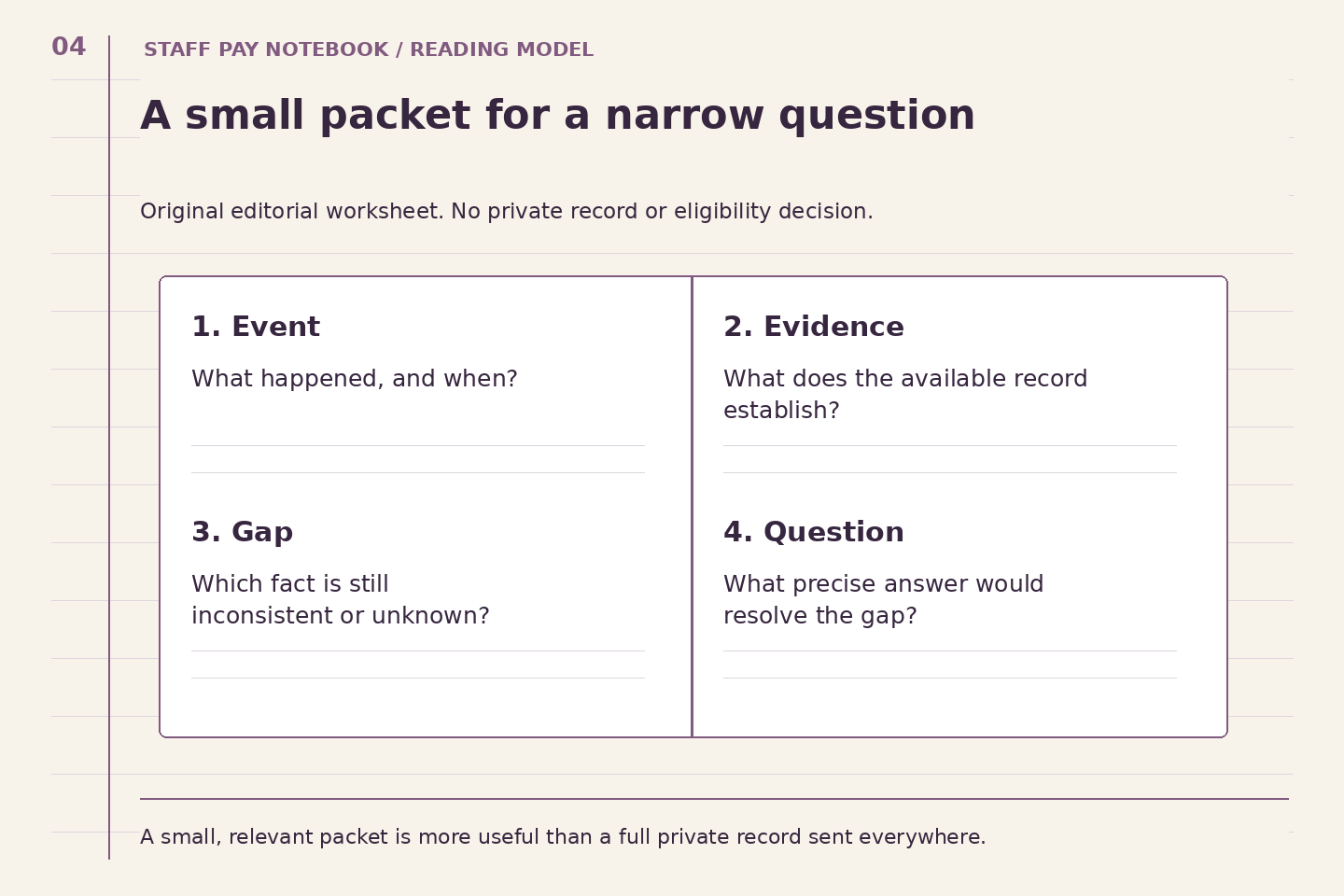
When a work record appears incomplete, it is tempting to forward every email and screenshot. That can bury the relevant event and expose unrelated personal information. A better starting point is one sentence naming the mismatch: a recorded date differs from a confirmation, an assignment is unclear, or a time entry does not match the work note. Build the packet around that sentence. This guide's event-ledger method is an original organizational aid; it is not an official University form or a legal procedure.
Keep events and evidence in separate columns
Create a short ledger with event date, event description, source, and confirmation status. The event is what you believe happened. The source is why you believe it. A scheduled shift, a contemporaneous work note, and a later approval message each prove different things, so keep their descriptions distinct. Add an attachment index only for documents actually needed to understand the issue. A clear index can say "supervisor confirmation, dated Thursday" without embedding a whole conversation full of unrelated names or other employees' details.
Understand the boundary of a personnel file
Policy 5-002 describes official personnel files broadly, including employment qualifications, assignments, compensation, performance, and benefit-related records. It provides a route to request inspection, copies, and challenges to factual accuracy, subject to stated limitations. A personal folder is not that official file, and a payroll question does not necessarily require a personnel-file request. Use the policy when the issue genuinely concerns the official record, and ask the appropriate custodian which record and process apply. This article does not interpret an individual's legal rights or predict an outcome.
Worked example: a transfer date is inconsistent
Consider a fictional employee whose written transfer confirmation names one effective date while a later employment document displays another. The employee creates three ledger rows: the confirmation received, the first workday in the new assignment, and the later document containing the different date. They do not assume that the first workday and the formal effective date must be identical. Their question is whether the records are consistent with the approved action and, if not, which record needs correction. The packet is now small enough for someone else to follow.
The employee attaches only the relevant confirmation and the portion of the later document that shows the disputed date, using the office's approved secure route. In the cover note, they identify the two dates and ask which is authoritative for the specific purpose at hand. If the office explains that the documents use dates with different meanings, the employee records that explanation. If a correction is needed, they ask how to verify completion. Neither result is presumed before the responsible office has reviewed the records.
Separate a request from a completed transaction
The University's eForms overview identifies personnel actions such as hiring, job changes, and employment-status changes as departmental transaction types. Its existence does not tell an employee that a particular action has been submitted, approved, or applied. In your ledger, give those stages separate status labels whenever the distinction matters. "Manager requested" should not become "record changed" merely because a form exists. Ask for the responsible department contact and the next verifiable milestone rather than trying to infer progress from an unrelated screen or a calendar alone.
Minimize the information that travels
Start a routine inquiry with the least detail needed to locate the issue, then follow the verified office's instructions for any sensitive supporting material. Do not place banking details, Social Security numbers, medical explanations, or other people's records in a general-purpose note. A screenshot can reveal more than its visible headline, so review the whole image before sharing it. If the question requires a secure submission, use the current official route. This site does not collect documents, authenticate employees, or act as a channel to University HR.
Define what a satisfactory answer would establish
Before sending the packet, finish the sentence: "I will know this is resolved when…" For a date discrepancy, resolution might be a confirmed explanation of the fields or a corrected document. For a time-record question, it may be confirmation of the approved record and the payment in which it will be reviewed. Avoid demanding a particular technical fix when you do not know the underlying cause. State the outcome you need to establish and let the office identify the appropriate process within its authority.
Keep follow-up factual and proportionate
If the expected checkpoint arrives without a clear result, follow up using the original question and any reference the office supplied. Add only genuinely new information. Re-sending a growing archive each time makes it harder to see what changed. If your situation affects an immediate deadline, name that deadline clearly without presenting it as the University's guaranteed turnaround time. Keep copies in an appropriate secure location and follow applicable workplace rules for records. This article supplies no universal retention period and no permission to copy confidential institutional material.
Close the ledger without erasing its history
Once resolved, add the answer, date, source, and any future check that remains. Preserve the difference between your initial observation and the confirmed result. That distinction is valuable if the same question returns later or a different office needs context. The source review for this guide occurred October 1, 2026. Policy 5-002 retains an October 11, 2011 effective date, so a recent source check must not be misrepresented as a new policy. The practical goal is an accurate, bounded record that helps the right person answer one question.
Try the Five-Clocks Reading Lab to prepare a bounded question.
Continue reading: Why a Workweek and a Pay Period Need Separate Lines, Employment Verification: Decide What Must Be Verified Before Sharing, Compare Posted Pay Ranges Without Inventing a Salary.