In this guide
Two date ranges can both be correct
A pay-period boundary and a workweek boundary organize time for different purposes. If you draw only one of them, a question about a late-week shift can be hard to explain. The University's Staff Compensation policy places the workweek from Saturday at 12:00 a.m. through Friday at midnight. Its public payroll FAQ explains that a workweek crossing a pay period can affect when overtime appears. Those facts identify a timing issue to investigate; they do not establish an individual's overtime amount or eligibility.
Draw two strips before doing any calculation
This article's two-strip method uses an ordinary calendar. On the first strip, mark the pay period shown on the record. On the second, mark the workweek dates that overlap it. Then place the actual work dates on both strips. Do not fill the margins with estimated pay yet. The point is to find whether the question involves an incomplete week, a missing entry, or an amount already attached to a completed interval. Each possibility needs different evidence and may require a different explanation from Payroll.
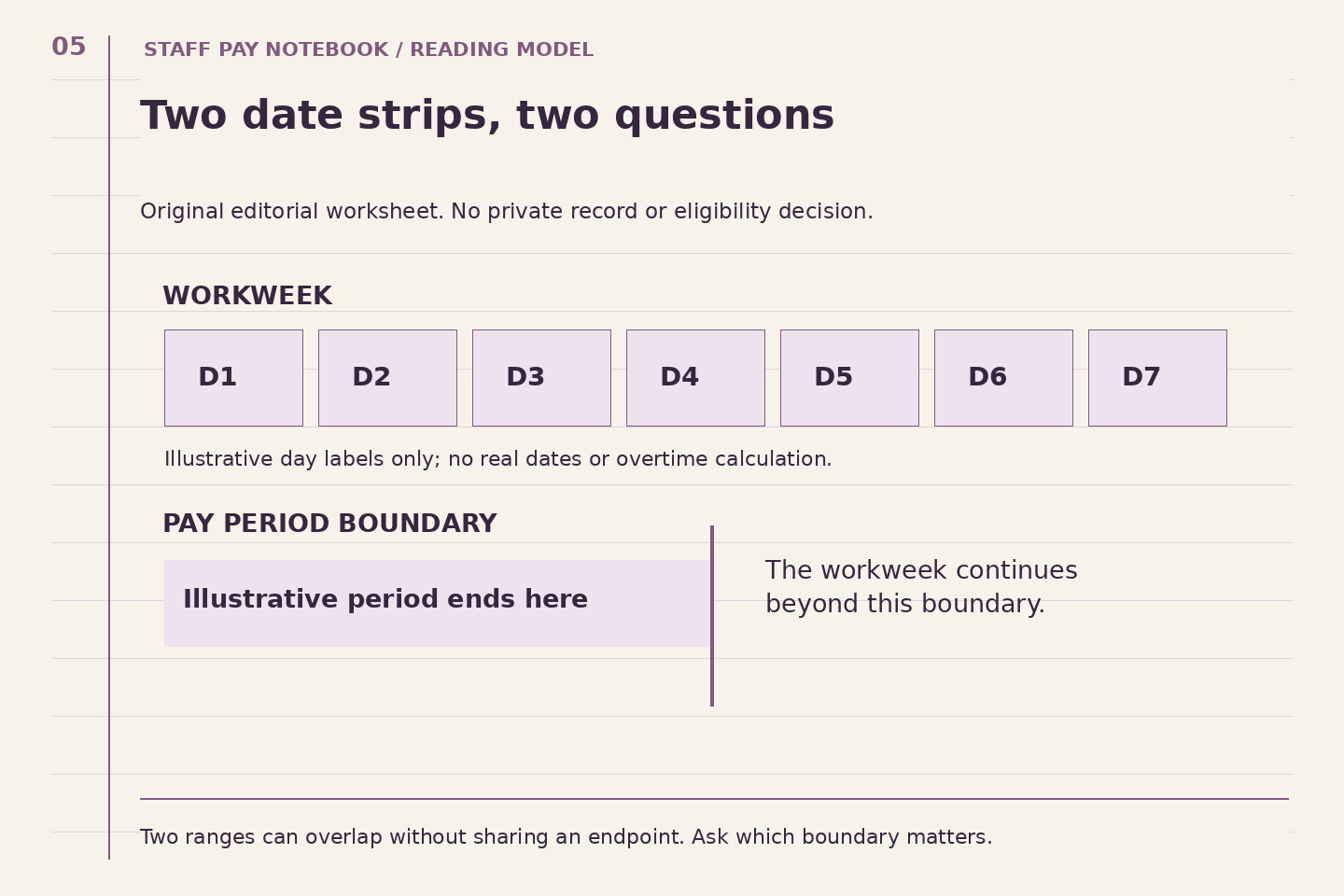
Worked example: the period ends midweek
Imagine a hypothetical non-exempt employee reviewing a pay period that ends on a Wednesday. Their workweek continues through Friday. They circle Wednesday on the upper strip and Friday on the lower one, then list their actual start and stop records for the relevant days. They can now ask whether the item they are looking for belongs to the week ending Friday rather than assuming it must appear with every hour before Wednesday. This is a calendar illustration, not a determination that any extra payment is owed.
Suppose the answer is still unclear because one day's time has not been confirmed. The employee identifies that missing record first. They do not estimate the day's hours from a recurring schedule or copy a neighboring week's total. A scheduled interval and an actual time record answer different questions. The resulting inquiry can name the workweek, the pay-period boundary, and the unconfirmed day in a few lines. That gives the department a more useful starting point than a single unexplained total.
Keep rate questions distinct from timing questions
The University's payroll FAQ is labeled as an October 6, 2023 change notice. It explains that the displayed rate can represent the regular rate rather than an overtime multiplier. That historical explanation is a reason to check the label carefully, not a reason to declare a current statement wrong or right. A timing question asks where an item belongs. A rate question asks how a field was determined. Put them in separate sentences so an answer to one does not appear to resolve both.
End with a bounded check
Bring the actual dates and relevant record to the responsible department or Payroll through its approved route. Ask which statement should be reviewed and which line answers the question. Do not treat this exercise as personal wage-law advice or an overtime calculator. Sources were checked October 1, 2026, and the FAQ's historical date remains visible because source age matters. The useful result is a clear pair of date ranges and one precise unresolved question, not a speculative earnings figure.
Continue reading: Two University Jobs: Keep Time Attached to the Right Assignment, Employee Pay and Student Refunds: Name the Money Before Seeking Help, Benefits Questions to Resolve Before an Offer Decision.